Frequently Asked Questions

Thermal Properties of Carbon Fiber

What is thermal conductivity and why is it important in material selection?

Thermal conductivity measures how efficiently heat flows through a material. It is crucial in applications where heat transfer affects performance or longevity, such as electronics, aerospace, and industrial equipment. Materials with higher thermal conductivity transfer heat more efficiently, while those with lower values act as insulators. For carbon fiber, thermal conductivity can vary widely depending on the fiber type and orientation. Note: The specific value for a carbon fiber composite depends on its construction and should be verified for each application.

What are the typical thermal conductivity values for carbon fiber compared to other materials?

Thermal conductivity for standard modulus (34 Msi) carbon fiber (fiber only) ranges from 9 to 11 W/mK, while ultra high modulus (110 Msi) carbon fiber (fiber only) can reach up to 200 W/mK. For comparison, AISI 1018 carbon steel is 51.9 W/mK, 6061-T6 aluminum is 167 W/mK, water is 0.598 W/mK, and gold is 310 W/mK. Note: The thermal conductivity of a carbon fiber composite part depends on fiber orientation and matrix, and may differ from the fiber-only values.

How does the direction of measurement affect the thermal conductivity of carbon fiber composites?

The thermal conductivity of carbon fiber composites is typically higher when measured along the fiber direction and lower when measured across the fibers. This anisotropy means that the design and layup of the composite will significantly impact its thermal performance. Note: Always confirm the direction of measurement when evaluating thermal conductivity data for your application.

Can carbon fiber composites be engineered for high or low thermal conductivity?

Yes, manufacturers can tailor carbon fiber composites for either high or low thermal conductivity depending on the application. For example, high thermal conductivity carbon fiber has been used to suppress battery degradation in mobile electronics. The choice of fiber type, orientation, and matrix all influence the final thermal properties. Note: Custom engineering may increase lead time and cost; consult with DragonPlate for project-specific requirements.

What is the coefficient of thermal expansion (CTE) and how does it relate to carbon fiber?

The coefficient of thermal expansion (CTE) measures how much a material changes in size when exposed to temperature changes. For carbon fiber, the CTE can vary greatly depending on fiber orientation and matrix. Carbon fiber can even have a negative CTE, meaning it shrinks when heated. Typical CTE values for carbon fiber laminates (0/90 woven) are around 0.15 x 10⁻⁵ K-1, compared to 1.2 x 10⁻⁵ K-1 for carbon steel and 2.36 x 10⁻⁵ K-1 for 6061-T6 aluminum. Note: The CTE of a composite part depends on its layup and resin system; always verify for your specific application.

Why can carbon fiber have a negative coefficient of thermal expansion?

Carbon fiber can have a negative coefficient of thermal expansion because its atomic structure is fixed along the x and y axes by strong covalent bonds, while the z direction is held by weaker Van Der Waals forces. When heated, atoms vibrate mainly in the z direction, pulling neighboring atoms closer and causing the material to shrink in the x and y directions. This property can be useful in applications where dimensional stability is critical. Note: Not all carbon fiber composites exhibit negative CTE; it depends on fiber orientation and matrix composition.

How can the coefficient of thermal expansion of carbon fiber composites be tailored for specific applications?

By combining carbon fibers (which can have negative or near-zero CTE) with resin matrices that have positive CTE, manufacturers can engineer composites with an overall CTE close to zero. This is valuable in applications like metrology equipment, where even small dimensional changes can affect accuracy. Note: Achieving a specific CTE requires careful design and may not be feasible for all geometries or performance requirements.

Product Features & Technical Capabilities

What types of carbon fiber products does DragonPlate offer for applications requiring specific thermal properties?

DragonPlate offers a wide range of carbon fiber products, including sheets, plates, tubes, sandwich panels, and specialty items such as high-temperature and flame-retardant composites. These products can be customized for thermal conductivity and expansion properties through tailored laminate schedules and fiber orientations. Note: Not all products are suitable for extreme thermal environments; consult technical documentation or contact DragonPlate for guidance. See technical specs.

How does DragonPlate ensure the quality and consistency of its carbon fiber products?

DragonPlate's manufacturing facility is ISO 9001:2015 certified, ensuring high-quality standards and consistent production processes. Advanced engineering tools, such as Finite Element Analysis (FEA), are used to optimize designs and material usage. Note: While certification ensures process quality, specific performance characteristics should always be validated for each application. View ISO certificate.

Use Cases & Applications

What industries benefit from carbon fiber's unique thermal properties?

Industries such as aerospace, robotics, medical devices, defense, and electronics benefit from carbon fiber's customizable thermal conductivity and low or negative coefficient of thermal expansion. For example, high thermal conductivity carbon fiber is used in electronics to manage heat, while low or negative CTE is valuable in precision equipment. Note: Suitability depends on the specific product and application requirements; always consult technical documentation.

Can you provide examples of real-world applications where carbon fiber's thermal properties are critical?

One example is the use of high thermal conductivity carbon fiber in battery enclosures for mobile electronics to suppress battery degradation. Another is the use of carbon fiber composites with near-zero CTE in metrology equipment, where dimensional stability is essential. Note: Application-specific engineering is required to achieve desired thermal properties; not all off-the-shelf products will meet these needs.

Technical Documentation & Support

Where can I find technical specifications and design guides for DragonPlate carbon fiber products?

Technical specifications for DragonPlate products are available on the technical specs page. For design and application guidance, refer to The Ultimate Guide to Carbon Fiber Design and Application. Downloadable CAD models are also available to assist with integration. Note: Always review the latest documentation for your specific product and application.

What support does DragonPlate offer for selecting materials with specific thermal properties?

DragonPlate provides technical support and custom engineering services to help customers select or design materials with the desired thermal conductivity and coefficient of thermal expansion. Customers can contact the team via phone at 315-252-2559 or email at service@dragonplate.com for assistance. Note: Detailed limitations not publicly documented; ask sales for specifics regarding extreme or highly specialized thermal requirements.

Loading...

Carbon Fiber Thermal Conductivity and the Coefficient of Thermal Expansion

When designing a new product or application, engineers have multiple options for materials. Properly analyzing all material properties, while putting them into the context of the end product or application, is an extremely difficult task. Two thermal properties that could play an important role in material selection are thermal conductivity and the coefficient of thermal expansion.

In any heat transfer application, thermal conductivity and the coefficient of thermal expansion should be carefully considered, especially in applications where these properties affect performance and longevity. Selecting a material with the proper thermal conductivity can improve efficiency and performance. Carbon fiber can be utilized in novel applications due to its unique thermal properties.

Thermal Conductivity

In the simplest terms, thermal conductivity is a measure of how efficiently heat flows through a given material. Materials with a simple molecular structure typically will have a higher thermal conductivity. When a material is heated, particles will gain energy and vibrate more. This vibration causes molecules to bump into other particles and transfer energy to them. The more heat is applied, the more vibration and energy transfer occurs.

Thermal conductivity is represented mathematically below:
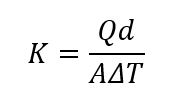
K = Thermal Conductivity (W/(mK)) or (Btu/(hrft*°F))

Q = Amount of Heat Transferred (W) or (Btu)

d = Distance Between the Two Isothermal Planes (m) or (ft)

A = Surface Area (m²) or (ft²)

ΔT = Change in Temperature (K) or (°F)

Thermal conductivity varies greatly depending on the material. Due to the fact that there are so many variations of carbon fiber, each variation will have its own unique properties, unlike other materials, such as water. Check out the table below to see the different thermal conductivities of various materials.

Material

Thermal Conductivity (W/mK)

Water

0.598

Standard Modulus (34 Msi) Carbon Fiber (Fiber Only)

9 to 11

AISI 1018 Carbon Steel

51.9

6061-T6 Aluminum

167

Ultra High Modulus (110 Msi) Carbon Fiber (Fiber Only)

200

Gold

310

Manufacturers and researchers have developed carbon fiber composites that have high thermal conductivity or low thermal conductivity, depending on the application. The way that thermal conductivity is measured can also affect the final measurement. If the thermal conductivity is measured along the fiber, then the conductivity is usually higher than if the measurement is taken across the fiber.

Carbon fiber with high thermal conductivity can be used in a variety of applications. For example, a Japanese company developed carbon fiber that suppressed battery degradation in mobile applications for electronic devices. The end application should dictate whether an engineer needs carbon fiber with low or high thermal conductivity.

Another key thermodynamic property that engineers should take into account is the coefficient of thermal expansion.

Coefficient Of Thermal Expansion

The coefficient of thermal expansion is a measure of how the size of an object changes when exposed to a change in temperature.

There are three types of coefficients of thermal expansion:

-        Volumetric

-        Area

-        Linear

Due to the fact that carbon fiber is generally solid in most applications, area and linear coefficients of thermal expansion are the two that an engineer should be most concerned with.

Below is the mathematical representation of the coefficient of linear thermal expansion:
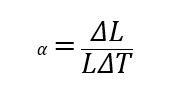
α = Coefficient of Area Thermal Expansion (K-1 or 1/K) or (°F-1 or 1/°F)

L = Original Length (m) or (ft)

ΔL = Change in Length (m) or (ft)

ΔT = Change in Temperature (K) or (°F)

Below is the mathematical representation of the coefficient of area thermal expansion:
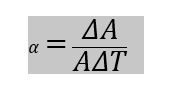
α = Coefficient of Area Thermal Expansion (K-1 or 1/K) or (°F-1 or 1/°F)

A= Original Area (m²) or (ft²)

Delta A= Change in Area (m²) or (ft²)

Delta T = Change in Temperature (K) or (°F)

Similar to thermal conductivity, the coefficient of thermal expansion for carbon fiber can vary greatly. The coefficient largely depends on the direction of the carbon fibers in the matrix. The typical range of coefficient of thermal expansion is anywhere from -1 K-1 to +8 K-1.  Check out the table below to see the different coefficients of thermal expansion of various materials.

Material

Coefficient of Thermal Expansion (K-1)

Diamond

0.1 x 10⁻⁵

Carbon Fiber Laminate (0/90 woven)

0.15 x 10⁻⁵

AISI 1018 Carbon Steel

1.2 x 10⁻⁵

Gold

1.42 x 10⁻⁵

6061-T6 Aluminum

2.36 x 10⁻⁵

Lead

2.9 x 10⁻⁵

Carbon fiber can have a negative coefficient of thermal expansion. When the material is heated, it will shrink. Carbon fiber atoms are often fixed along the x and y axes. The plane bonds that hold the fibers in place in the x and y axes are covalent. This leaves the z direction unfixed and held together by much weaker Van Der Waals forces.

When carbon fiber is heated the atoms will begin to vibrate, mostly in the z direction. When this occurs, the vibrating atoms will pull on neighboring atoms. This entire phenomenon will bring the atoms closer together and constrict the material in the x and y directions. The material will continue to shrink as the heat increases and the atoms begin to vibrate more.

This property can yield some interesting results when used in certain applications. Carbon fibers can be incorporated into a resin matrix with a positive coefficient of thermal expansion where the resulting matrix will have a coefficient of thermal expansion close to zero. This can be useful for some applications where small movements can be critical, such as metrology equipment.

Leave your comment
Loading...