Frequently Asked Questions

Product Information & Assembly

What are the recommended methods for connecting carbon fiber tubes?

DragonPlate recommends using purpose-built carbon fiber tube connectors rather than drilling or pinning, which can compromise tube strength. Available connector types include modular connectors (blocks, cubes, links, clevis), molded pultruded connectors, threaded end and quick-release connectors, and carbon fiber plate gussets. These connectors allow for easy assembly and disassembly, adjustable angle joints, and preserve structural integrity. Note: Drilling into tube walls is not recommended as it weakens the tube. Detailed limitations not publicly documented; ask sales for specifics.

How do modular carbon fiber tube connectors work?

Modular connectors are made from anodized aluminum and use a patented ridged and slotted design to strengthen the bond and prevent metal-to-carbon delamination caused by differential thermal expansion. Assembly involves sanding the tube interior, cleaning surfaces, mixing and applying epoxy, inserting the connector, and wiping excess adhesive. These connectors enable the creation of lightweight, rigid structures with easy assembly and disassembly. Note: Modular connectors are best suited for roll-wrapped tubes; not all tube types may be compatible.

What are the steps for assembling carbon fiber tube structures using molded pultruded connectors?

To assemble structures with molded pultruded connectors: mockup the joint, sand the bonding area, clean surfaces, apply epoxy, assemble using supplied plastic screws or slide the connector onto the tube, and clean excess epoxy. Quick-release connectors allow for easy assembly/disassembly and can be locked or set to rotate. Note: Molded pultruded connectors are intended for less demanding applications; not suitable for high-stress environments.

How are square and rectangular carbon fiber tubes connected?

Plate gussets are used to reinforce structures built with square or rectangular tubes. The gusset thickness matches the tube wall. Assembly involves mockup, drilling rivet holes, sanding, cleaning, applying epoxy, attaching with supplied rivets, and cleaning excess epoxy. Refer to kit instructions for details. Note: Plate gussets require drilling, which may affect tube strength; consult technical documentation for best practices.

Features & Capabilities

What are the key features of DragonPlate carbon fiber tube connectors?

DragonPlate connectors offer modularity, easy assembly/disassembly, adjustable angle joints, and compatibility with various tube shapes (round, square, rectangular, hexagonal, tapered, airfoil). The patented ridged/slotted design prevents metal-to-carbon delamination. Connectors are available for roll-wrapped, pultruded, and telescoping tubes. Note: Compatibility varies by tube type; check product specs for details.

How does DragonPlate ensure the structural integrity of carbon fiber tube assemblies?

DragonPlate avoids methods like drilling or pinning that weaken tube walls. Instead, connectors are designed to preserve tube strength and prevent delamination. Assembly instructions emphasize proper surface preparation and epoxy bonding. For roll-wrapped tubes, modular connectors are recommended; for pultruded tubes, molded connectors and quick-release systems are used. Note: Improper assembly or use of non-recommended methods may compromise structural integrity.

Technical Requirements & Documentation

Where can I find technical documentation and assembly guides for DragonPlate products?

Technical documentation, including assembly guides and specifications, is available on the DragonPlate website. Key resources include The Ultimate Guide to Carbon Fiber Design and Application, downloadable CAD models (CAD models), and detailed specs (Technical Specs). Refer to kit instructions for specific connector systems. Note: Some documentation may require registration or direct inquiry.

Use Cases & Applications

What types of structures can be built using DragonPlate carbon fiber tubes and connectors?

DragonPlate tubes and connectors enable the creation of complex two-dimensional and three-dimensional structures, including trusses, camera boom arms, lighting fixtures, portable tools, and custom assemblies for aerospace, robotics, and industrial applications. The modular system allows for lightweight, stiff, and easily portable designs. Note: Suitability depends on application requirements; consult engineering resources for high-stress or specialized uses.

Who can benefit from DragonPlate carbon fiber tube connectors?

Engineers, designers, and project managers in aerospace, robotics, medical devices, defense, and industrial automation can benefit from DragonPlate connectors. The system is ideal for projects requiring lightweight, durable, and modular structures. Note: Teams needing specialized compliance or extreme environmental resistance should review product specs or consult sales for fit.

Pricing & Ordering

How is DragonPlate product pricing determined?

DragonPlate product prices are listed on the website in US Dollars and are subject to change without notice. Shipping, freight, taxes, and handling charges are additional and calculated based on weight, dimensions, and shipping method. Customization options (e.g., CNC cutting, tailored laminate schedules) may incur extra charges. Payment is typically prepaid via credit card, check, or wire transfer; Net 30 terms are available for approved buyers. Bulk discounts may apply for larger orders. Note: Pricing does not include shipping or taxes; check the Terms and Conditions for details.

Support & Implementation

How easy is it to start using DragonPlate carbon fiber tube connectors?

DragonPlate connectors and tubes are designed for user-friendly integration. Prefabricated components can be cut, drilled, and bonded without specialized equipment. Technical guides and CAD models are available to reduce the learning curve. For custom solutions, Element6 Composites offers design and prototyping services. Support is available via phone (315-252-2559) and email (service@dragonplate.com). Note: Custom projects may require additional lead time depending on complexity.

Certifications & Quality Assurance

Is DragonPlate ISO certified?

Yes, DragonPlate operates an ISO 9001:2015-certified facility, ensuring high-quality manufacturing standards and consistent product reliability. Note: Certification applies to manufacturing processes; individual product compliance may vary by application.

Customer Proof & Success Stories

Can you share examples of customers successfully using DragonPlate connectors?

DragonPlate connectors have been used in diverse applications, including marine defense (Frontier Electronic Systems), drone technology (Eureka Dynamics), nuclear and industrial robotics (International Climbing Machines), aerospace student rockets, and lightweight musical instruments. Case studies and demos are available: Marine Defense, Drone Technology, Industrial Robotics, Aerospace Rockets, Music Industry. Note: Results depend on project requirements; consult case studies for specifics.

Loading...

How to Connect Carbon Fiber Tubes

There are several ways to connect carbon fiber tubes, but some are structurally more preferable. Some carbon fiber tube manufacturers connect tubes by drilling into them and pinning or bolting them, but that is not a recommended method as it compromises the tube wall and weakens the tube. It is better to use DragonPlate carbon fiber tube connectors that that are are specifically designed for that purpose. There are several available, including:

By combining carbon fiber tubes and these connectors, you can easily create complex two-dimensional or three-dimensional structures that are easy to assemble and disassemble and allow for adjustable angle joints.
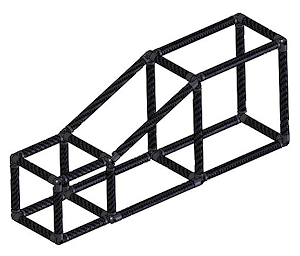
connecting round carbon tubes

Connecting Roll Wrapped Carbon Fiber Tubes Using Modular Connectors

Roll-wrapped tubes are best connected using modular connectors. Modular connectors are made from anodized aluminum. Using a patented ridged and slotted design, these connectors are designed to strengthen the bond against the possibility of metal-to-carbon delamination caused by the differential thermal expansion of carbon fiber and aluminum.

It is quite simple to assemble modular carbon fiber tube connectors:

  1. Lightly sand the inside of the tube.
  2. Clean the surfaces that will be bonded.
  3. Mix the epoxy.
  4. Apply the epoxy.
  5. Insert the connector.
  6. Wipe away any excess adhesive.

By combining various modular connectors and roll wrapped carbon fiber tubes, a wide range of lightweight and stiff carbon fiber tube structures can be built.
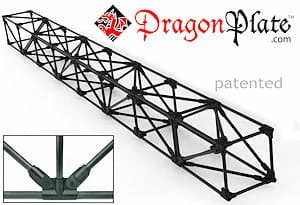
pultruded carbon tube connectors

Connecting Pultruded Carbon Fiber Tubes Using Molded pultruded carbon fiber tube connectors and Quick-Release Connectors

For less demanding applications, molded pultruded carbon fiber tube connectors can be used to create complex structures with pultruded carbon fiber tubes. Threaded end connectors with a quick release can be used to allow easy assembly and disassembly of tubes and tube structures. Long truss structures comprised of shorter segments of up to eight feet in length can thus be built. Due to the low weight and high strength of carbon fiber tubes, this application is particularly useful for camera boom arms, lighting fixtures, or tools that can be broken down for easier transportation.

To assemble CF tube structures structures using the Molded carbon fiber pultruded tube connectors

  1. Mockup the joint.
  2. Sand the bonding area.
  3. Clean the surfaces to be bonded.
  4. Apply the epoxy to the tube and connector
  5. Assemble the structure by using the supplied plastic screws to assemble the molded gussets around the tube or slide the multi-angle connector on to the end of the tube.
  6. Clean any excess epoxy.

To install quick-release carbon fiber tube connectors:

  1. Follow the instructions above for modular connectors to bond the two quick-release connector adapters into the ends of the pultruded carbon fiber tubes.
  2. Thread the quick-release male and female ends into these aluminum adapters.

A locking version of the quick-release connector is available for single-use applications, prohibiting rotation when the lock is engaged. Alternatively, a version is also available that contains a groove that allows the component to rotate. This simple groove in the quick-release connector eliminates the need for complex fixturing when assembling sections of the truss.
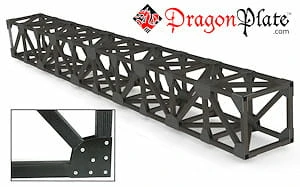
connecting square carbon tubes

Connecting Square and Rectangular Carbon Fiber Tubes Using Plate Gussets

Plate gussets are used to reinforce carbon fiber tube structures built with square or rectangular tubes. The carbon fiber laminate thickness of the plate gusset kit equals the thickness of the tube wall. To assemble carbon fiber plate gussets with carbon fiber tubes:

  1. Mockup the joint.
  2. Drill small rivet holes to match the plate gusset into the carbon fiber tube.
  3. Sand the bonding area.
  4. Clean the surfaces to be bonded.
  5. Apply the epoxy.
  6. Use the supplied rivets to attach the gusset to the tube.
  7. Clean any excess epoxy.

Note: Refer to the detailed instructions provided with the plate gusset kit for actual assembly.

An infinite combination of lightweight and robust structures can be built using plate gussets to connect square and rectangular carbon fiber tubes.

By combining various shapes and styles of carbon fiber tubes and carbon fiber tube connectors, you can create just about any structure you can imagine. As with all carbon fiber products, these structures are durable, strong, and lightweight. When combined with the proper connectors, they can be built for quick and easy assembly and disassembly, allowing ease of portability to be added to the list of features. By selecting connectors that do not require drilling into the carbon fiber tubes, you also ensure that the structural integrity and strength of the carbon fiber tubes remain intact. Now it’s time to get designing. All that stands in your way is your imagination!
Shop Now

Loading...