Frequently Asked Questions

Product Information & History

What is the history of carbon fiber and how has it evolved?

Carbon fiber was first created in 1860 by Sir Joseph Wilson Swan for use in early incandescent light bulbs. Thomas Edison later used cellulose-based carbon fiber filaments in 1879. Modern carbon fiber, with its high strength-to-weight and stiffness-to-weight ratios, became possible through manufacturing improvements in the last half-century. In the early 1960s, Dr. Akio Shindo in Japan used polyacrylonitrile (PAN) as a precursor, leading to stronger and more cost-effective fibers. By the 1990s and 2000s, advances in manufacturing and material science enabled carbon fibers with up to 95% carbon content and tensile strengths of 4,000 MPa, making carbon fiber a popular material for advanced engineering applications. Note: Early carbon fiber was not as strong or cost-effective as today's materials. Source.

What products does DragonPlate offer?

DragonPlate offers a wide range of carbon fiber composite products, including:

Note: Not all products are suitable for every application; consult technical documentation for compatibility. Source.

Features & Capabilities

What are the key features and benefits of DragonPlate carbon fiber products?

Key features of DragonPlate products include:

Note: Some features may require custom orders or additional lead time. Source.

Does DragonPlate offer custom carbon fiber fabrication?

Yes, DragonPlate provides custom design, engineering, and prototyping services through its Element6 Composites division. Services include tailored laminate schedules, CNC cutting, and custom part fabrication for unique project requirements. Note: Custom projects may require additional lead time and cost; contact DragonPlate for details. Source.

What technical documentation and resources are available for DragonPlate products?

DragonPlate provides several technical resources, including:

Note: Some resources may require registration or direct inquiry for access.

Use Cases & Benefits

What industries and roles benefit most from DragonPlate products?

DragonPlate products are used by engineers, designers, product developers, and project managers in industries such as aerospace, robotics, medical devices, defense, industrial automation, marine defense, drone technology, nuclear and industrial robotics, and the music industry. These products are ideal for applications requiring lightweight, durable, and high-performance composite materials. Note: Not all products are suitable for every industry; review technical specs for compatibility. Source.

What business impact can customers expect from using DragonPlate products?

Customers can expect measurable improvements in cost efficiency (reduced manufacturing costs, lower rework rates), enhanced product performance (weight reduction, durability), accelerated time-to-market (streamlined prototyping, end-to-end services), simplified regulatory compliance (biocompatibility, radiolucency), and risk reduction (validated designs, ISO 9001:2015 certification). Note: Actual impact depends on project scope and implementation; detailed limitations not publicly documented—ask sales for specifics. Source.

Can you share specific case studies or customer success stories?

Yes, DragonPlate has supported a variety of projects, including:

Note: Results are project-specific; not all customers will achieve the same outcomes.

Pain Points & Problems Solved

What core problems do DragonPlate products solve?

DragonPlate addresses high manufacturing costs, complex manufacturing processes, localized stress concentrations, regulatory challenges, weight and performance optimization, prototyping and design validation issues, and material handling/safety concerns. Solutions include advanced FEA tools, end-to-end services, biocompatible materials, and CNC cutting. Note: Some challenges may require custom solutions or additional engineering support. Source.

What are common pain points expressed by DragonPlate customers?

Customers often report challenges such as inefficient part designs, excess material usage, labor-intensive fabrication, long cycle times, complex manufacturing processes, regulatory compliance hurdles, and safety concerns during material handling. DragonPlate addresses these with optimized design tools, prefabricated components, regulatory-compliant materials, and CNC services. Note: Not all pain points can be fully eliminated; some may require process changes or additional investment. Source.

Pricing & Plans

How is DragonPlate pricing determined?

DragonPlate's product prices are listed on the website in US Dollars and are subject to change without notice. Additional costs include shipping, freight, taxes, and handling, calculated based on weight, dimensions, and shipping method. Customization services may incur extra charges depending on project complexity. Payment is typically prepaid via credit card, check, or wire transfer; approved buyers may receive Net 30 terms. Bulk discounts may be available for large orders. Note: Prices do not include shipping or taxes; contact sales for custom quotes. Source.

Support & Implementation

How easy is it to implement DragonPlate products, and what support is available?

DragonPlate offers ready-to-use prefabricated components that can be cut, drilled, and bonded without specialized equipment. Comprehensive technical documentation, guides, and downloadable CAD models are available to assist with integration. For custom projects, Element6 Composites provides design and prototyping services. Customer support is available via phone (315-252-2559) and email (service@dragonplate.com). Note: Custom solutions may require additional time; immediate use is possible for off-the-shelf products. Source.

Certifications & Quality

Is DragonPlate ISO certified?

Yes, DragonPlate's manufacturing facility is ISO 9001:2015 certified, ensuring high-quality standards and consistent manufacturing processes. Note: Certification applies to manufacturing processes; specific product certifications may vary. Source.

Loading...

A Brief History of Carbon Fiber

Although carbon fiber has been around for more than 150 years, it has only been through manufacturing process improvements in the last half century or so that its excellent strength-to-weight and stiffness-to-weight ratios have been achieved. These modern advances, coupled with decreases in manufacturing costs over the last couple of decades, are what have made carbon fiber become such a popular material for design engineers to use in some of today's greatest technological advances.

Early Carbon Fiber History

Sir Joseph Wilson Swan first created carbon fiber in 1860 to use in an early incandescent light bulb. In 1879, Thomas Edison used cellulose-based carbon fiber filaments in some of the first light bulbs to be heated by electricity. Their high heat tolerance made them ideal electrical conductors. These filaments were made of cotton or bamboo, as opposed to today's petroleum-based raw materials, and then baked at high temperatures to cause carbonization to take place. This baking method, called "pyrolysis", is still used today. Pyrolysis is the process of thermally decomposing organic matter by heating it at high temperatures in an inert atmosphere. When tungsten became the light bulb filament of choice in the early 1900s, carbon fiber was rendered obsolete for the next 50 years or so.

In 1958, at the Union Carbide Parma Technical Center in Cleveland, OH, Roger Bacon accidentally produced the first petroleum-based carbon fibers when he tried to measure the triple point of carbon by heating strands of rayon in argon. He noticed filaments growing on the negative electrode of the arc furnace, and he noted this observation in his findings. However, the resulting fibers were only about 20% carbon and did not have nearly the stiffness and strength properties that are so highly valued in today's carbon fiber products, making Bacon's process highly inefficient. Additionally, his methods for creating the carbon fibers were extremely cost-prohibitive.

Modern Carbon Fiber
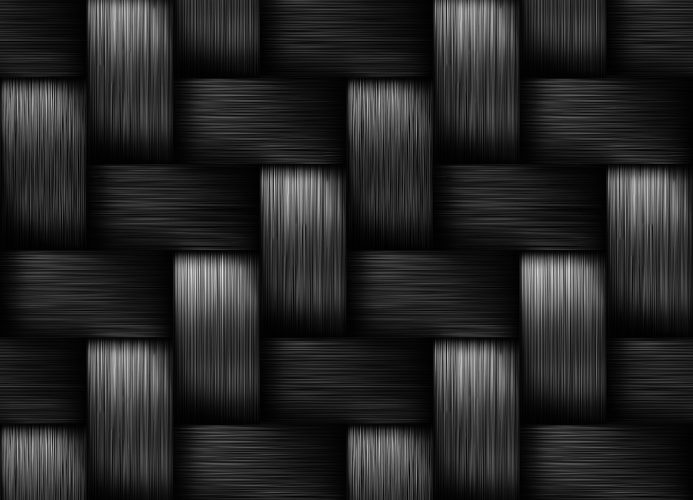
weaved carbon fiberIn the early 1960s, Dr. Akio Shindo, of the Agency of Industrial Science and Technology in Japan, used polyacrylonitrile (PAN) as his precursor. PAN is a synthetic, semicrystalline organic polymer resin that allowed Shindo to create carbon fibers that were ~55% carbon using a much more cost-effective production method.

In 1963, British scientists W. Watt, L. N. Phillips, and W. Johnson of the UK Ministry of Defence, patented a new carbon fiber manufacturing process. This manufacturing process created a much stronger carbon fiber product than previous processes yielded. The British National Research Development Corporation then licensed the process to Rolls Royce, Morganite, and Courtaulds. At the time, Rolls Royce was already manufacturing carbon fiber, and this new process allowed them to begin using carbon fiber in the design of their jet engine fan assemblies. They then broke into the US market with their RB-211 aero-engine with carbon fiber compressor blades. Unfortunately, bird impact proved to be a major vulnerability of the compressor blades, which led to major setbacks for Rolls Royce. Ultimately, Rolls Royce sold off their carbon fiber plant.

A joint technology agreement made in 1970 allowed Union Carbide to produce the PAN-based carbon fiber previously only manufactured by Toray Industries in Japan. Morganite had earlier decided that carbon fiber was not part of its core business, which left Courtaulds as the only U.K. manufacturer of carbon fiber. However, their inorganic process left impurities in the carbon fiber that were not seen in the organic process used by other carbon fiber manufacturers. By 1991, Courtaulds, a UK-based manufacturer of fabric, clothing, man-made fibers, and chemicals, stopped production of carbon fiber.

Carbon Fiber Today

Since the late 1970s, several other types of carbon fiber yarn have entered the global market. These newer fibers contain up to 95% carbon and have considerably increased tensile strength and modulus of elasticity over the earliest versions. For example, Toray Industries now manufacturers carbon fibers with a tensile strength of 4,000 MPa and a modulus of 400 GPa. Additionally, improved manufacturing processes have aided in a decrease in production costs. These improvements in strength, elasticity, and cost led engineers in the 1990s and 2000s to finally fully understand the vast potential of carbon fiber in a variety of manufacturing applications, making it a favorite design choice today.
Explore Element 6

Loading...