Frequently Asked Questions

Product Information: Carbon Fiber Weaves & Fabrics

What are the main types of carbon fiber weaves offered by DragonPlate?

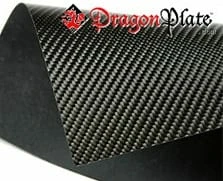
DragonPlate offers several carbon fiber weave types, including plain weave, twill weave (2x2 and 4x4), harness satin weave (4HS, 5HS, 8HS), and other specialty weaves such as fish weave, spread tow, braids, unidirectional, and custom weaves. Each weave has unique properties affecting strength, formability, stability, and crimp. For detailed product options, visit carbon fiber veneer sheets. Note: Not all weaves are suitable for every application; consult technical documentation for best fit.

How do plain weave, twill weave, and harness satin weave differ in performance and application?

Plain weave is highly stable and easy to handle, making it ideal for flat sheets and tubes but less suitable for complex contours due to its harsh crimp. Twill weave is more pliable and forms to complex shapes, with fewer stress points but requires careful handling to avoid distortion. Harness satin weaves (4HS, 5HS, 8HS) are the most formable and best for complex contours, but offer less stability. The higher the satin weave number, the more formable and less stable the fabric. Note: Each weave has trade-offs; plain weave is not recommended for highly contoured parts.

What factors should I consider when choosing a carbon fiber weave for my project?

Key factors include strength, formability, stability, and crimp. For flat or two-dimensional parts, plain weave is preferred for its stability. For complex shapes, twill or harness satin weaves offer better formability. Crimp affects stress points and long-term durability. Consult DragonPlate's technical documentation and guides for detailed recommendations. Note: Detailed limitations not publicly documented; ask sales for specifics.

Features & Capabilities

What are the key performance benefits of DragonPlate carbon fiber products?

DragonPlate carbon fiber composites offer a high strength-to-weight ratio, durability, and resistance to corrosion and environmental factors. Advanced engineering tools like Finite Element Analysis (FEA) optimize designs and reduce material waste. Customizable solutions, including tailored laminate schedules and CNC cutting, ensure products meet specific requirements. Materials are designed to meet industry standards such as biocompatibility and radiolucency for medical applications. Note: Best fit for projects requiring lightweight, high-strength materials; teams needing ultra-high flexibility may want to consider alternatives.

Does DragonPlate offer custom fabrication and engineering services?

Yes, DragonPlate provides custom design, engineering, and prototyping services through its Element6 Composites division. Services include tailored laminate schedules, CNC cutting, and custom part fabrication. The ISO 9001:2015-certified facility supports both prototypes and high-volume production. Note: Custom solutions may require additional lead time depending on project complexity.

What technical documentation and resources are available for DragonPlate products?

DragonPlate provides a comprehensive guide to carbon fiber design and application, downloadable CAD models, detailed technical specifications, and practical application resources. Access these at The Ultimate Guide, CAD models, and Technical Specs. Note: Some resources may require registration or direct inquiry for full access.

Use Cases & Benefits

What industries and roles benefit most from DragonPlate carbon fiber products?

DragonPlate products are used by engineers, designers, product developers, and project managers in aerospace, robotics, medical devices, defense, industrial automation, marine defense, drone technology, nuclear and industrial robotics, and the music industry. Case studies include collaborations with Frontier Electronic Systems (marine defense), Eureka Dynamics (drone technology), International Climbing Machines (robotics), aerospace student organizations, and musical instrument manufacturers. Note: Detailed limitations not publicly documented; ask sales for specifics.

Can you share specific customer success stories or case studies?

Yes. DragonPlate collaborated with Frontier Electronic Systems to design composite electrical enclosures for marine defense, partnered with Eureka Dynamics to enhance drone test bed systems, developed composite chassis for wall-climbing robots with International Climbing Machines, supported aerospace student teams in building high-performance rockets, and created lightweight guitar designs for the music industry. See marine defense case study, drone technology case study, robotics case study, rocket case study, and music industry demo. Note: Not all industries may find a direct fit; consult sales for custom solutions.

What business impact can customers expect from using DragonPlate products?

Customers can expect reduced manufacturing costs, lower rework rates, enhanced product performance (weight reduction, durability), accelerated time-to-market, simplified regulatory compliance, and risk reduction through validated designs and ISO 9001:2015-certified manufacturing. For example, aerospace teams achieved rockets soaring over 10,000 feet, and robotics companies improved chassis durability. Note: Impact varies by project complexity and industry; teams requiring ultra-low cost solutions may need to evaluate alternatives.

Pain Points & Solutions

What common challenges do DragonPlate products help solve?

DragonPlate addresses high manufacturing costs, complex fabrication processes, localized stress concentrations, regulatory challenges, weight and performance optimization, prototyping and design validation issues, and material handling safety concerns. Solutions include FEA-driven design, end-to-end services, biocompatible materials, and CNC cutting. Note: Not all pain points are solved for every industry; consult sales for specific limitations.

Technical Requirements & Implementation

How easy is it to implement DragonPlate products, and what is the typical timeframe?

DragonPlate offers prefabricated components that can be cut, drilled, and bonded without specialized equipment, enabling immediate integration. Technical guides and CAD models reduce the learning curve. Custom solutions via Element6 Composites require additional time based on project complexity. Customers can start with concept sketches or load requirements. For support, contact service@dragonplate.com or call 315-252-2559. Note: Custom projects may have longer lead times; off-the-shelf products are typically ready to use.

Pricing & Payment

What is DragonPlate's pricing model and what additional costs should buyers expect?

DragonPlate lists product prices in US Dollars on its website, subject to change without notice. Shipping, freight, taxes, and handling charges are additional and calculated based on weight, dimensions, and shipping method. Customization services may incur extra charges. Payment is typically prepaid via credit card, check, or wire transfer; Net 30 terms are available for approved buyers, with a 1.5% monthly service charge on unpaid balances. Bulk discounts may be available for larger orders. See Terms and Conditions for details. Note: Pricing does not include shipping or taxes; custom projects may have additional costs.

Support & Customer Service

What support options are available for DragonPlate customers?

DragonPlate provides responsive customer support via phone (315-252-2559) and email (service@dragonplate.com). Technical documentation, guides, and CAD models are available online. Customers can manage orders, wishlist, and account information directly on the website. Note: Some technical questions may require direct inquiry for detailed answers.

Loading...

Carbon Fiber 101: Understanding Weaves and Fabrics

Carbon fibers are often woven into fabrics after they have been manufactured and sized. The manufacturing process begins by creating bundles of carbon fibers called tows. These tows are then rated according to the number of fibers or filaments they contain, which is commonly referenced as 3k, 6k, 12k, and 48k. The "k" stands for "thousand," meaning a 3k tow comprises 3,000 carbon filaments. Each strand of carbon fiber is only about 5-10 microns thick, but the high number of these strong carbon fibers in such a compact space gives carbon fiber materials incredible strength.

Carbon Fiber Weaves

Carbon fiber spools are woven into fabrics on a weaving loom. The most common weaves are plain weave, twill, and harness satin.

Plain weave
Plain Weave

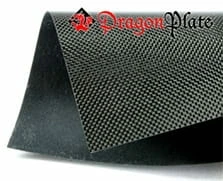
Plain weave, or 1x1 weave, carbon fiber fabric is symmetrical and resembles a checkerboard. The tows are woven in an over/under pattern, offering tightly interlaced fibers which are highly stable. Fabric stability refers to a material’s ability to maintain its fiber orientation and weave angle. Because of its high fabric stability, plain weave carbon fiber fabric doesn’t work well for complex contours because it is not particularly flexible. However, it is easier to handle without creating distortions in the fabric. Therefore, it works well for flat sheets, tubes, and two-dimensional curves.

Crimp is the curvature of a single fiber in a weave, and plain weave carbon fiber fabric has a harsh crimp due to the tight interlaces in the tows. This harsh crimp can create stress points that cause areas of weakness over time.
Shop Now

Twill Weave

Twill Weave

Twill weave consists of a 2x2 or 4x4 pattern and is the most commonly recognized type of carbon fiber fabric. In a 2x2 weave, each tow passes over two tows and then under two tows. It stands to reason, then, that a 4x4 weave consists of each tow passing over four tows and then under four tows. This over/under weaving creates a distinct diagonal pattern The distance between the tow interlaces in a twill weave is longer than with a plain weave. Therefore, fewer crimps occur, allowing less opportunity for stress points to be created.

Twill weave is pliable and can form to complex contours while still maintaining good stability. It must be handled more carefully than a plain weave fabric to avoid adding distortions to the weave. A 4x4 weave is easier to form than a 2x2 weave, but it also has less fabric stability.

Harness Satin Weave
Harness Satin Weave

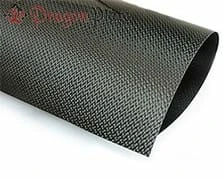
Satin weaves have been used for thousands of years to give silk fabric its beautiful draping quality while leaving the fabric smooth and seamless. When used for carbon fiber composites, satin weaves translate to an ability to easily form around complex contours. Obviously, this means satin weaves also offer less stability than other weaves.

The most common harness satin weaves are four harness satin (4HS), five harness satin (5HS), and eight harness satin (8HS). The number indicates the total number of tows passed over then under. For example, a 4HS weave consists of three tows passed over and then one passed under. For 5HS, four tows are passed over, and then one under, and 8HS is seven tows passed over and one under. The higher the satin weave number, the more formable and less stable it is.

Other weaves
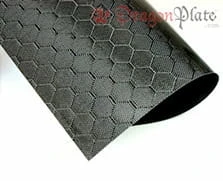
Other Weaves

There are a number of other weaves that can be used to create carbon fiber fabrics. These include fish weave, spread tow, braids, unidirectional weave and custom weaves. Each weave contains unique properties that make it great for use in some designs and not a good choice for others. Many factors must be considered when determining which carbon fiber weave should be used for a particular function. These factors include strength, formability, stability, and crimp. Carbon fiber fabricators are experts in knowing which fabric to use for which design.

Loading...