Frequently Asked Questions

Carbon Fiber vs Aluminum: Performance & Comparison

How does carbon fiber compare to aluminum in terms of strength and stiffness?

Carbon fiber has a modulus of elasticity of 70 GPa, nearly identical to aluminum's 68.9 GPa, meaning both materials are similarly stiff. However, carbon fiber's ultimate tensile strength is 1035 MPa, compared to aluminum's 450 MPa, making carbon fiber approximately 2.3 times stronger. Its specific tensile strength (strength-to-weight ratio) is 647, versus aluminum's 166, so carbon fiber is about 3.8 times stronger per unit weight. Note: These values are generalizations; actual performance depends on the specific carbon fiber grade and layup. Carbon fiber parts are significantly more expensive and require careful engineering to avoid sudden failure when overloaded. Source

What are the thermal properties differences between carbon fiber and aluminum?

Aluminum has a thermal expansion of 13 in/in/°F, while carbon fiber's is only 2 in/in/°F. This means aluminum expands about six times more than carbon fiber when heated. Carbon fiber's low thermal expansion is advantageous for applications requiring dimensional stability, such as optical devices and precision instruments. Note: Carbon fiber's lower thermal conductivity may be a limitation for applications needing rapid heat dissipation. Source

What are the main advantages and disadvantages of carbon fiber compared to aluminum?

Carbon fiber offers a higher strength-to-weight and stiffness-to-weight ratio than aluminum, making it ideal for applications where weight reduction is critical. It also provides superior dimensional stability under temperature changes. However, carbon fiber does not yield; it bends elastically and fails suddenly if overloaded, requiring careful engineering and safety factors. Carbon fiber is also significantly more expensive due to high production costs and the skill required for fabrication. Aluminum is less expensive and more forgiving in overload scenarios. Source

Features & Capabilities

What features and capabilities does DragonPlate offer for carbon fiber products?

DragonPlate provides high-performance carbon fiber composites with a high strength-to-weight ratio, durability, and environmental resistance. Products include sheets, tubes, structural components, sandwich panels, and specialty items like flame-retardant and high-temperature composites. DragonPlate uses Finite Element Analysis (FEA) for design optimization, offers CNC cutting and custom laminate schedules, and ensures regulatory compliance for medical and defense applications. Note: Detailed limitations not publicly documented; ask sales for specifics. Source

Does DragonPlate offer modular carbon fiber tube connectors?

Yes, DragonPlate offers a patented modular carbon fiber tube connector system, enabling easy assembly of lightweight and rigid structures. This system is suitable for robotics, aerospace, and industrial automation applications. Note: Compatibility with non-standard tube sizes may require custom solutions. Source

Use Cases & Benefits

What industries and roles benefit most from DragonPlate carbon fiber products?

DragonPlate products are used by engineers, designers, and project managers in aerospace, robotics, medical devices, defense, industrial automation, and commercial equipment. Case studies include marine defense (Frontier Electronic Systems), drone technology (Eureka Dynamics), nuclear and industrial robotics (International Climbing Machines), aerospace student organizations, and the music industry. Note: For applications requiring rapid heat dissipation or cost-sensitive projects, aluminum may be preferable. Source

Can you share specific customer success stories using DragonPlate products?

DragonPlate collaborated with Frontier Electronic Systems to design composite electrical enclosures for marine defense, ensuring waterproof performance and EMI shielding. Eureka Dynamics improved drone test bed systems with carbon fiber components. International Climbing Machines used DragonPlate for durable robot chassis in nuclear environments. Aerospace student teams built rockets achieving over 10,000 feet altitude, and the music industry adopted lightweight guitar designs. Note: These examples highlight versatility, but custom solutions may require additional lead time. Source

Pain Points & Solutions

What common challenges do DragonPlate products help solve?

DragonPlate addresses high manufacturing costs, complex fabrication processes, localized stress concentrations, regulatory challenges, weight and performance optimization, prototyping and design validation, and material handling safety. Solutions include FEA-driven design, end-to-end services, biocompatible and radiolucent materials, and CNC cutting. Note: For projects with limited budgets or requiring rapid prototyping, aluminum may offer faster turnaround. Source

Technical Requirements & Documentation

Where can I find technical specifications and design guides for DragonPlate products?

Technical specifications are available at dragonplate.com/dragonplate-weights-specs. The Ultimate Guide to Carbon Fiber Design and Application provides step-by-step instructions (Access the guide). Downloadable CAD models are also available (CAD models). Note: For highly specialized applications, consult DragonPlate engineering for custom documentation. Source

Pricing & Ordering

How is DragonPlate pricing determined and what are the payment terms?

DragonPlate product prices are listed in US Dollars and are subject to change without notice. Shipping, freight, taxes, and handling charges are additional and calculated based on weight, dimensions, and shipping method. Customization options (e.g., CNC cutting) may incur extra charges. Payment is typically prepaid via credit card, check, or wire transfer; approved buyers may receive Net 30 terms, with a 1.5% per month service charge for unpaid balances. Bulk discounts may be available for larger orders. Note: For detailed pricing, refer to Terms and Conditions. Source

Support & Implementation

How easy is it to implement DragonPlate products and what support is available?

DragonPlate offers prefabricated components that can be cut, drilled, and bonded without specialized equipment, enabling quick integration. Comprehensive guides, CAD models, and responsive customer support are available. For custom projects, Element6 Composites provides design and prototyping services. Customers can manage orders and account information online. Note: Custom solutions may require additional lead time depending on project complexity. Source

Certifications & Compliance

Is DragonPlate ISO 9001:2015 certified?

Yes, DragonPlate's manufacturing facility is ISO 9001:2015 certified, ensuring consistent quality and reliability in production. This certification is particularly important for customers in regulated industries such as aerospace, medical, and defense. Note: Certification details are available at ISO Certification PDF. Source

Loading...

Carbon Fiber vs Aluminum
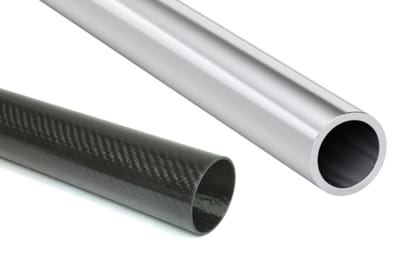
Carbon fiber is replacing aluminum in an increasing variety of applications and has been doing so for the last few decades. These fibers are known for their exceptional strength and rigidity and are also extremely lightweight. Carbon fiber strands are combined with various resins to create composite materials. These composite materials take advantage of the properties of both fiber and resin. This article provides a comparison of the properties of carbon fiber versus aluminum, along with some pros and cons of each material.

Carbon Fiber vs Aluminum Measured

Below are the definitions of the different properties used to compare the two materials:

  • Modulus of elasticity = The “stiffness” of a material. The ratio of stress to strain for a material. The slope of the stress vs strain curve for a material in its elastic region.
  • Ultimate tensile strength = the maximum stress a material can withstand before breaking.
  • Density = the material’s mass per unit volume.
  • Specific stiffness = Modulus of elasticity divided by the material’s density. Used for comparing materials with dissimilar densities.
  • Specific tensile strength = Tensile strength divided by the material’s density.

With this information in mind, the following chart compares carbon fiber and aluminum.

  • Note: Many factors can affect these numbers. These are generalizations; not absolute measurements. For example, different carbon fiber materials are available with higher stiffness or strength, often with a trade-off in reduction of other properties.
    MeasurementCarbon FiberAluminumCarbon/Aluminum
    Comparison
    Modulus of elasticity (E) GPa7068.9100%
    Tensile strength (σ) MPa1035450230%
    Density (ρ) g/cm31.62.759%
    Specific stiffness (E/ρ)43.825.6171%
    Specific tensile strength (σ /ρ)647166389%

    This chart shows that carbon fiber has a specific tensile strength of approximately 3.8 times that of aluminum and a specific stiffness of 1.71 times that of aluminum.

Comparing thermal properties of carbon fiber and aluminum

Two more properties that show the differences between carbon fiber and aluminum are thermal expansion and thermal conductivity.

  • Thermal expansion describes how a material’s dimensions change when temperatures change.
MeasurementCarbon FiberAluminumAluminum/Carbon
Comparison
Thermal expansion2 in/in/°F13 in/in/°F6.5


Aluminum has approximately six times the thermal expansion of carbon fiber.

Pros and Cons

When designing advanced materials and systems, engineers must determine which material properties are most important for specific applications. When high strength-to-weight or high stiffness-to-weight matters, carbon fiber is the obvious choice. In terms of structural design, when added weight could shorten life cycles or lead to poor performance, designers should look to carbon fiber as the better building material. When toughness is essential, carbon fiber is easily combined with other materials to obtain the necessary characteristics.

Carbon fiber’s low thermal expansion properties are a significant advantage when creating products that require a high degree of precision, and dimensional stability in conditions where temperatures fluctuate: optical devices, 3D scanners, telescopes, etc.

There are also a few disadvantages to using carbon fiber. Carbon fiber does not yield. Under load, carbon fiber will bend but will not permanently conform to the new shape (elastic). Once the ultimate tensile strength of the carbon fiber material is exceeded carbon fiber fails suddenly. Engineers must understand this behavior and include safety factors to account for it when designing products. Carbon fiber parts are also significantly more expensive than aluminum because of the high cost to produce carbon fiber and the great skill and experience involved in creating high-quality composite parts.

Have a question about using carbon fiber in your application? CONTACT US
Shop Now

Loading...