Frequently Asked Questions
Product Quality & Identification
How can I identify a high-quality carbon fiber sheet?
To identify a high-quality carbon fiber sheet, check for perfect flatness—there should be no waves, warps, bends, or creases when placed on a flat surface. Inspect the finish: gloss sheets should appear glass-like and crystal clear, with visible, uncrushed fibers and no bumps or indentations. Matte sheets should have a smooth, less reflective finish, while textured sheets are intended for bonding and should display a fine fabric texture from the peel-ply process. Also, verify fiber straightness and correct angular orientation, as defects can affect both appearance and mechanical properties. Finally, ensure the sheet's dimensions are within ±0.125" of the stated size. Note: Not all suppliers meet these standards; always verify before purchasing. Source.
What are the differences between gloss, matte, and textured carbon fiber sheet finishes?
Gloss carbon fiber sheets have a glass-like, crystal-clear finish that highlights the texture of the fibers beneath, with no bumps or indentations. Matte sheets are less reflective, with a smooth surface that is more resistant to scratches. Textured sheets are designed for adhesive bonding and display the fine fabric texture left by peel-ply fabric, lacking a cosmetic finish. Note: The choice of finish affects both appearance and application suitability. Source.
Why is fiber straightness important in carbon fiber sheets?
Fiber straightness ensures both the cosmetic appearance and mechanical properties of carbon fiber sheets. Misaligned or wavy fibers can indicate problems with ply orientation, potentially reducing strength and reliability. Always check that fibers are straight and at the correct angular orientation. Note: Fiber misalignment may also signal issues in underlying layers not visible on the surface. Source.
What dimensional tolerances should I expect from quality carbon fiber sheets?
High-quality carbon fiber sheets typically have cutting tolerances of ±0.125 inches (1/8"). Always verify that the sheet's actual dimensions are within this range of the stated product size. Note: Sheets outside this tolerance may not fit your application as intended. Source.
Features & Capabilities
What features and capabilities does DragonPlate offer for carbon fiber sheets and related products?
DragonPlate offers a wide range of carbon fiber products, including veneer sheets (plain, twill, hybrid), solid sheets and plates (EconomyPlate™, quasi-isotropic, high modulus, high-temp prepreg), sandwich sheets with various cores (birch, balsa, honeycomb), tubes (roll-wrapped, braided, airfoil, telescoping), structural components (angles, I-beams, C-channels, D-Tube Neck Beams™), high-temperature and flame-retardant products, Kevlar composites, adhesives, and specialty kits. Custom fabrication, CNC cutting, and prototyping services are also available. Note: Not all features are available for every product type; check product pages for specifics. Product Catalog
What performance advantages do DragonPlate carbon fiber sheets provide?
DragonPlate carbon fiber sheets are engineered for a superior strength-to-weight ratio, enhanced durability, and resistance to environmental challenges. Advanced engineering tools like Finite Element Analysis (FEA) are used to optimize designs and reduce material waste. These features are critical for industries such as aerospace, robotics, and industrial automation. Note: For applications requiring extreme impact resistance, consider Kevlar or hybrid options. Learn more about FEA
Does DragonPlate offer custom carbon fiber sheet fabrication?
Yes, DragonPlate provides custom fabrication services, including CNC cutting, custom sheet sizes, and specialized laminate schedules to meet unique performance and design requirements. Customers can start with concept sketches or load requirements, and DragonPlate's team will assist with design, prototyping, and manufacturing. Note: Custom solutions may require additional lead time compared to off-the-shelf products. Explore customization options
Use Cases & Industries
What industries and applications use DragonPlate carbon fiber sheets?
DragonPlate carbon fiber sheets are used in aerospace (aircraft, UAVs, rockets), robotics (frames, end-of-arm tooling), medical devices (radiolucent, biocompatible structures), industrial automation (robotic arms, automation systems), defense (tactical gear, marine enclosures), and musical instruments. Case studies include cost savings in industrial automation, drone technology, and wall-climbing robots. Note: Some applications may require regulatory compliance or specialized materials. Case Study
Can you share examples of customer success using DragonPlate carbon fiber sheets?
Yes. For example, a customer in industrial automation achieved $1 million in annual savings by implementing a custom carbon fiber robotic arm solution. Other case studies include aerospace student organizations developing rockets, defense collaborations for marine enclosures, and robotics companies optimizing wall-climbing robots. Note: Results vary by application and project scope. Read the case study
Pain Points & Problem Solving
What common problems do DragonPlate carbon fiber sheets help solve?
DragonPlate carbon fiber sheets address high manufacturing costs, complex fabrication processes, localized stress concentrations, regulatory challenges, and the need for weight and performance optimization. Advanced engineering tools and custom solutions help reduce material waste, streamline manufacturing, and ensure compliance for industries like medical and defense. Note: Some challenges, such as extreme regulatory requirements, may require additional consultation. Learn more
What are the main pain points customers face when sourcing carbon fiber sheets?
Customers often face high manufacturing costs due to inefficient designs, excess material usage, and labor-intensive processes. Other pain points include complex manufacturing steps, stress concentrations at geometry changes, regulatory hurdles (especially in medical and defense), and challenges in balancing weight with strength and durability. DragonPlate addresses these with advanced engineering, custom fabrication, and regulatory expertise. Note: Some pain points, such as late-stage design changes, may still impact project timelines. Source
Technical Resources & Support
What technical documentation and resources are available for DragonPlate carbon fiber sheets?
DragonPlate provides downloadable CAD models, technical guides (such as The Ultimate Guide to Carbon Fiber Design and Application), detailed weights and specs, fiber specification data sheets, and a comprehensive FAQ. Additional resources include a finishes page and a carbon fiber glossary. Note: Some technical documents are specific to certain product lines; verify applicability before use. CAD Models | Design Guide
How quickly can I implement DragonPlate carbon fiber sheets into my project?
DragonPlate offers ready-to-use prefabricated carbon fiber sheets that can be cut, drilled, and bonded without specialized equipment, allowing for immediate integration into projects. For custom solutions, additional lead time may be required depending on complexity. Technical documentation and CAD models are available to support rapid implementation. Note: Custom fabrication timelines vary; contact support for estimates. CAD Models
How can I get support or technical assistance for DragonPlate products?
Support is available via the DragonPlate FAQ, shipping and returns information, and direct contact through the website or by phone at 315-252-2559 (Mon-Fri 8:30am – 5:00pm ET). For custom projects or technical questions, you can also reach out to the Element 6 Composites team. Note: Response times may vary during peak periods. Contact Support
Certifications & Compliance
Are DragonPlate carbon fiber sheets manufactured to any quality standards?
Yes, all DragonPlate products are manufactured under ISO 9001:2015 quality standards at their facility in Elbridge, New York. This certification ensures consistent quality and reliability for demanding applications. Note: For projects requiring additional certifications, contact sales for details. ISO Certificate
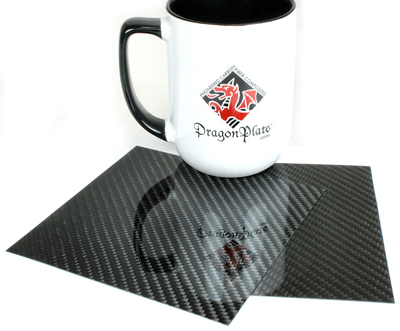 Carbon fiber sheeting is a high-performance product, and can be relatively expensive to purchase. Unfortunately, there are companies selling less expensive carbon fiber products which are of lower quality. Purchasing carbon fiber sheeting is definitely a time when "you get what you pay for." If a project justifies the expense of using carbon fiber sheet over another material, it is wise to do your research and invest in a quality product, rather than looking only for the lowest price. Here are a few characteristics to look for, to ensure you’re making a quality purchase.